
How Executives Can Lead Digital Transformation
A digital transformation strategy for executives is a leadership plan that decides how far the business will change, who owns the change and how progress will be measured. Technology matters, but it comes second. In fact, the first decisions are about ambition, accountability and people.
This guide is written for CEOs, founders and senior leaders. First, it explains what B2B digital transformation involves and what research says about success. Then, it covers the CEO role in digital transformation. Finally, it offers a practical way to build a strategy that holds up.
What Is B2B Digital Transformation?
B2B digital transformation is the use of digital tools, data and new ways of working to change how a business sells, serves customers and operates with other businesses. However, it covers far more than buying software. For example, it can change how buyers find you, how deals are approved, how teams share data and how decisions are made.
It matters in B2B because buying involves several people, large budgets and long timelines. When information is easy to reach and processes are easy to follow, friction falls for customers and for your own teams. That is why digital transformation is important for B2B. For this reason, it belongs on the executive agenda and not only with the technology team.
Most B2B digital transformation starts in four areas. Also, the table shows what changes in each and the question an executive should ask.
| Area | What Changes | Question for the Executive |
|---|---|---|
| Sales and Buying | How buyers research, compare and approve | Can a buyer find answers without waiting for a call? |
| Operations | How work moves between teams and partners | Where do handoffs slow us down? |
| Data | How information is shared and used | Who trusts the numbers we report? |
| Customer Service | How issues are raised and resolved | How quickly does a customer get a clear answer? |
Why Many Digital Transformations Struggle
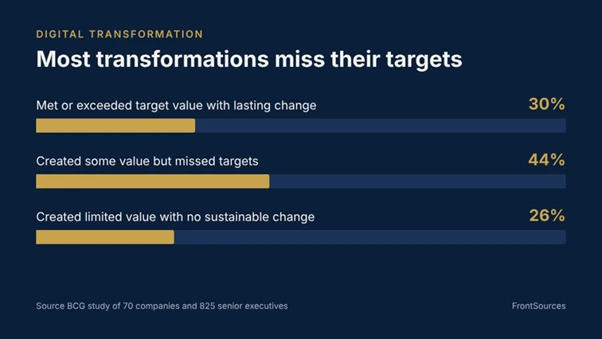
Boston Consulting Group studied transformation outcomes using internal data from 70 companies and a survey of 825 senior executives. As a result, it found that only 30 percent of transformations met or exceeded their target value and produced lasting change. Meanwhile, another 44 percent created some value but missed targets. Finally, 26 percent created limited value with no sustainable change.
McKinsey found a similar picture. In its Global Survey of 1,793 participants, only 16 percent said their digital transformations had improved performance and equipped the organization to sustain the change.
A note on numbers. You will often see a claim that 70 percent of digital transformations fail. One review of the evidence found that this figure blends several studies with different definitions of success. It is safer to rely on named research and to measure your own results.
The CEO Role in Digital Transformation
Deloitte’s research draws on interviews with more than 400 CEOs over five years. It argues that the CEO role in digital transformation depends on two things, how ambitious the change is and how ready the organization is. Ambition ranges from digitizing current processes to changing how the business makes money. Readiness covers leadership, culture, structure and capabilities. Deloitte also notes that most CEOs set their ambition too low, often because of internal constraints and not because of strategy.
So what is the role of the CEO in digital transformation? In short, to set the ambition, explain why the change matters and make sure the right people and resources are in place. Deloitte also advises dedicating full time resources early. The table shows how the role shifts, in a simplified view of Deloitte’s four scenarios.
| Ambition | Readiness | What the CEO Should Do |
|---|---|---|
| High | High | Act as a cheerleader and track progress |
| High | Low | Lead culture change and drive execution personally |
| Low | High | Back the parts of the organization that want change |
| Low | Low | Step back, seek outside challenge and examine personal barriers |
Questions to Ask Before You Start
Before you write a digital transformation strategy for executives to follow, ask five questions.
- First, what customer or business problem are we solving?
- Next, how far are we willing to change to solve it?
- Then, who owns the outcome, and who reports on it?
- Also, what will we stop doing to make room for the change?
- Finally, how will we know it worked?
However, if the leadership team cannot answer these in plain words, the plan is not ready.
How to Build a Digital Transformation Strategy
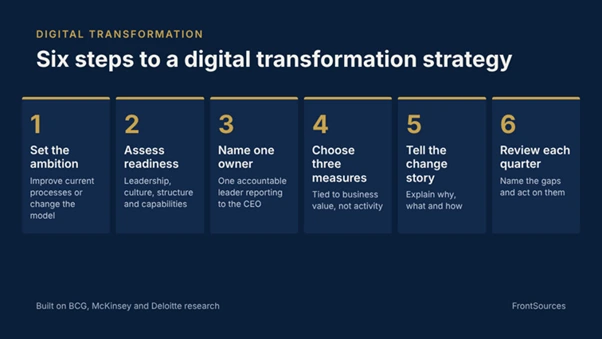
Many leaders ask how to build a digital transformation strategy without it becoming a technology shopping list. For this reason, use six steps. In addition, a digital transformation strategy for executives works best when it stays short and specific.
- First, set the ambition. Decide whether you are improving current processes or changing the business model.
- Next, assess readiness. Check leadership, culture, structure and capabilities honestly.
- Then, name one accountable owner who reports to the CEO.
- After that, choose three measures tied to business value, not activity.
- Also, tell a clear change story that explains why, what and how.
- Finally, review every quarter, name the gaps and act on them. BCG notes that waiting for perfection is neither practical nor desirable.
Here is an illustration, not a case study. Imagine a distribution company whose CEO wants to shorten the time between a quote request and an approved order. She checks readiness and finds that sales and operations keep separate data. She names one owner and chooses three measures, which are quote turnaround, the share of orders placed online and repeat orders after two quarters. The plan stays focused because the goal is a business result and not a tool.
Digital Transformation Best Practices From the Research
McKinsey’s survey gives the clearest guide to digital transformation best practices for any leadership team. The table lists what respondents who reported success were more likely to have done.
| Practice | Reported Effect on Success |
|---|---|
| Communicate a clear change story | More than three times as likely |
| Engage a chief digital officer | 1.6 times as likely |
| Senior leaders encourage staff to challenge old ways of working | 1.5 times as likely |
| Redefine roles to match transformation goals | 1.5 times as likely |
| Adopt tools that make information easier to reach | More than doubles the likelihood |
These are survey associations from research conducted in 2018, not proof of cause. Treat them as direction, not as a guarantee.
Digital Transformation Leadership in Practice
Strategy becomes real through behavior, and digital transformation leadership is mostly about what leaders do repeatedly.
- Learn from peers. Leaders who have already done this can save you months. Strong executive networking strategies give you access to them.
- Learn from other leaders’ decisions. An executive interview feature, such as those published by FrontSources, lets a leader explain what they chose and why. Our guide on how to interview a CEO shows which questions bring out the useful answers.
- Respect sector differences. Change looks different in each industry, as seen in how FinTech is redefining banking, healthcare technology and patient care and supply chain technology.
- Let AI serve the strategy. Tools should support your goals, as explained in our piece on AI tools and agents for business growth.
- Check your sources. Decisions are only as good as the evidence behind them, so know where executives get credible market insights.
How to Measure Digital Transformation Success
BCG judged success on the share of target value met, whether results arrived on time, how the effort compared with others and whether the change was sustainable. You can use the same logic. Track three measures.
- Value delivered against the target you set at the start.
- Adoption by the teams and customers the change was meant to serve.
- Whether results hold for at least two quarters after launch.
Record them monthly and review them each quarter. If a measure cannot be explained in one sentence, it is probably too complicated to manage.
Common Mistakes to Avoid
- Starting with tools instead of ambition.
- Setting ambition too low because of internal limits.
- Treating transformation as a technology project owned only by the IT team.
- Declaring success before the change has lasted.
Conclusion
A sound digital transformation strategy for executives starts with ambition, honest readiness checks and clear ownership, then adds technology. The research shows that most efforts fall short of their targets, so the leaders who succeed are those who measure results and keep adjusting.
FrontSources is a digital business magazine for founders, CEOs and professionals, publishing executive interviews, leadership stories and business trends. You can learn more on the About Us page, explore a business magazine cover story, return to the home page or get in touch to share your own leadership story.
Sources
- FAQ
It is a leadership plan that sets the ambition, ownership and measures for changing how a business operates and competes. However, technology supports the plan and does not lead it.
The CEO sets the ambition, explains why the change matters and ensures the right people and resources are in place. In addition, the level of personal involvement depends on how ambitious the change is and how ready the organization is.
First, set the ambition and assess readiness. Next, name one owner, choose three business measures and tell a clear change story. Finally, review progress every quarter.
The CEO should own the direction, with one accountable leader running delivery. In fact, many organizations appoint a chief digital officer to do this.
Track value delivered against target, adoption by teams and customers, and whether results last. Then, review them each quarter.