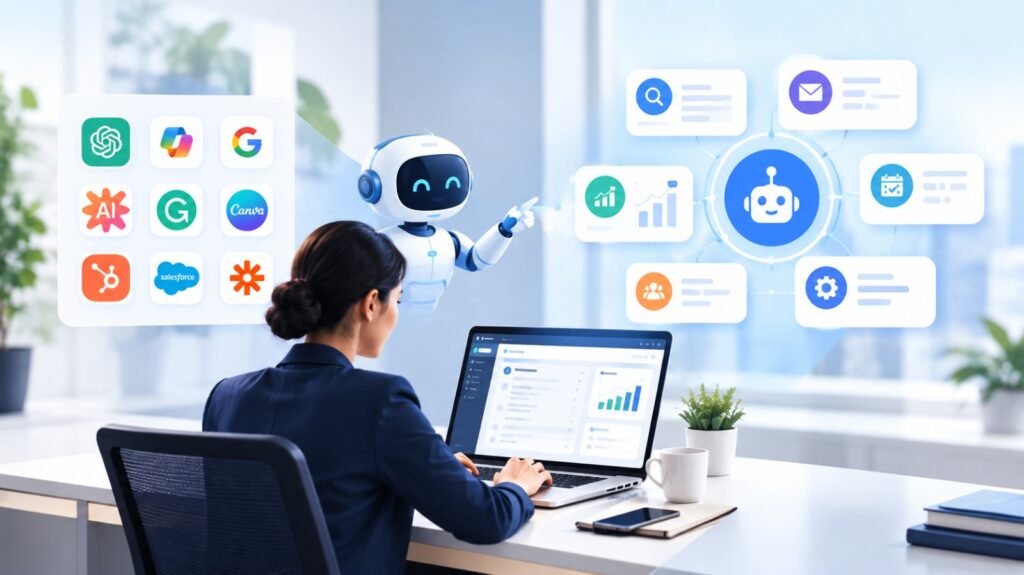
AI Tools and Agents for Business Growth
AI tools and AI agents serve different purposes in business.
- AI tools generally help employees complete specific tasks faster or make better decisions.
- AI agents are designed to handle a sequence of tasks toward a defined business objective, often by using multiple tools or connected business systems.
The distinction matters because a company evaluating AI should first understand which tasks need assistance and which workflows could benefit from greater automation.
AI Tools Businesses Can Use
| AI Tool / Platform | Business Use | How It Helps |
|---|---|---|
| ChatGPT | Research, writing, analysis, brainstorming | Helps teams analyze information, create drafts, summarize documents and develop ideas |
| Microsoft Copilot | Workplace productivity | Assists with documents, emails, meetings, spreadsheets and other Microsoft 365 workflows |
| Google Gemini | Research and workplace productivity | Helps with content, analysis, information discovery and productivity tasks |
| Claude | Research, writing and document analysis | Gartner, April 2026Useful for long-form analysis, summarization and business documentation |
| Grammarly | Business communication | Improves clarity, grammar, tone and professional communication |
| Canva AI | Marketing and design | Helps teams create presentations, marketing assets and visual content |
| HubSpot AI | Marketing and CRM | Supports content, customer engagement, sales and CRM-related workflows |
| Salesforce AI | Sales and customer management | Helps sales teams analyze customer information, automate tasks and support decision-making |
| Zapier AI | Workflow automation | Connects applications and helps automate repetitive business processes |
Important: The article should not present these tools as universally “best.” The right choice depends on the company’s workflow, data requirements, existing software, security policies and business objectives.
How AI Tools Help B2B Businesses
1. Sales
AI tools can help sales teams:
- Research prospects
- Summarize customer interactions
- Draft personalized emails
- Analyze sales pipelines
- Prioritize leads
- Prepare meeting notes
- Identify patterns in customer data
Example:
Instead of spending hours researching every prospect manually, a salesperson can use AI to prepare an initial research summary and then
spend more time validating the information and building the customer relationship.
2. Marketing
AI tools can support:
- Content research
- Campaign planning
- Audience analysis
- Content drafting
- SEO research
- Email personalization
- Performance analysis
The human marketing team still decides what the brand should say, who it should target and whether the message reflects the company’s positioning.
3. Customer Service
AI can help businesses:
- Answer routine questions
- Categorize support requests
- Summarize customer conversations
- Route issues to the right team
- Search internal knowledge bases
- Provide faster first responses
This is particularly valuable for companies handling large volumes of repetitive enquiries.
4. Recruitment and HR
AI tools can help HR teams with:
- Job-description drafting
- Resume organization
- Candidate matching
- Interview scheduling
- Candidate communication
- Skills analysis
- Workforce data analysis
However, AI should support recruitment decisions rather than make them independently. A candidate’s experience, career changes, communication style, potential and cultural contribution can require human interpretation. Historical recruitment data can also contain bias.
A practical model is: AI assistance → Human review → Hiring decision
5. Business Operations
AI tools can reduce administrative workloads by supporting:
- Document processing
- Data analysis
- Report creation
- Workflow management
- Meeting summaries
- Internal knowledge search
- Routine communication
The biggest benefit is often not replacing an employee. It is giving employees more time for higher-value work.
What Are AI Agents?
An AI agent is an AI-based system that can work through multiple steps to accomplish a defined objective, potentially using tools, business data and connected applications.
A simple AI tool might answer: “Summarize this customer report.”
An AI agent could potentially perform a broader workflow:
Customer data → Analyze account → Identify issue → Check CRM → Prepare response → Update record → Notify employee
The exact capabilities depend on the agent, integrations, permissions and human controls.
AI Agents for B2B Businesses
AI agents become particularly interesting when businesses have repeatable, multi-step workflows.
Sales Agent
A sales agent could potentially:
- Research an account
- Identify relevant contacts
- Analyze previous interactions
- Prepare a prospect summary
- Draft outreach
- Update CRM information
- Schedule follow-up tasks
Human value: The salesperson reviews the information, decides whether the prospect is genuinely relevant and manages the relationship.
Customer Service Agent
A customer-service agent could potentially:
- Receive a support request
- Identify the customer’s account
- Search approved knowledge
- Classify the issue
- Prepare an answer
- Escalate complex cases
- Update the support system
This can reduce repetitive work while keeping sensitive or complex cases under human control.
Recruitment Agent
A recruitment agent could potentially:
- Review applications against defined criteria
- Organize candidates
- Identify relevant skills
- Schedule interviews
- Send routine communications
- Update recruitment systems
But the final hiring decision should remain with qualified human decision-makers, particularly where judgment, fairness and context matter.
Finance Agent
Depending on the system and controls, an agent could assist with:
- Invoice processing
- Expense categorization
- Financial document analysis
- Reporting workflows
- Identifying unusual transactions
- Preparing information for financial review
Financial decisions still require appropriate controls, approvals and professional oversight.
| AI Tools | AI Agents |
|---|---|
| Usually perform a specific task | Can manage multiple steps |
| Primarily assist users | Can execute defined workflows |
| User often initiates each task | Agent may work toward a defined objective |
| Examples include writing, research and analysis tools | Examples include sales, service and workflow agents |
| Lower implementation complexity in many cases | Usually requires stronger integration and governance |
| Human remains actively involved | Human oversight remains important, especially for high-impact actions |
Simple business example
AI tool: “Write a follow-up email to this prospect.”
AI agent: “Review this prospect’s recent activity, determine the appropriate follow-up, prepare the email, update the CRM and create a follow-up task according to company rules.”
That distinction gives readers a practical understanding of why AI agents can have a larger operational impact than individual AI tools.
Where AI Tools and Agents Create the Most Value
For B2B companies, prioritize AI where work is:
- Repetitive
- Time-consuming
- Data-heavy
- Rules-based
- High-volume
- Spread across multiple systems
- Easy to measure
Avoid starting with the question: “Where can we use AI?”
A better executive question is: “Which business process consumes significant resources and could be improved without compromising quality, security or accountability?”
That shift makes the article much more experience-driven and authoritative rather than another generic list of AI tools.
Conclusion
- Tools accelerate tasks; agents own workflows — the distinction determines your ROI, not the vendor you pick.
- Start with the process draining the most resources, not with what AI is capable of doing.
- Human oversight isn’t a constraint on scale — it’s the reason scale is safe.
- FAQ
An AI tool completes a specific task when prompted — drafting an email or summarizing a report. An AI agent carries out a sequence of steps toward a broader objective, often across multiple systems, with less manual prompting at each stage.
Look for processes that are repetitive, time-consuming, data-heavy, or spread across multiple systems. Start with what’s draining resources, not with what the technology can theoretically do.
Not typically. The real value is freeing employees from repetitive work so they can spend more time on tasks that require judgment, relationship-building, or strategic thinking.
Generally, yes. Agents require stronger system integration, clearly defined permissions, and ongoing governance since they act across workflows rather than completing one task at a time.
No. AI can organize candidates, flag transactions, or prepare summaries, but final decisions should stay with qualified humans — especially where judgment, fairness, or compliance are involved.