
How to Interview a CEO
A CEO interview looks simple from the outside. You prepare a list of questions, press record and write down what you hear. In practice, the interviews readers remember rest on much more than a question list.
Senior executives are asked about growth, vision and industry trends so often that their answers can sound rehearsed before the second question. The real opportunity is to find something the audience has not heard before, such as a decision, a lesson, a setback or a change of mind. This guide explains how to interview a CEO from the first email to the final edit, including follow up questions, a 30 minute structure and the sensible use of AI.
How to Interview a CEO in Five Steps
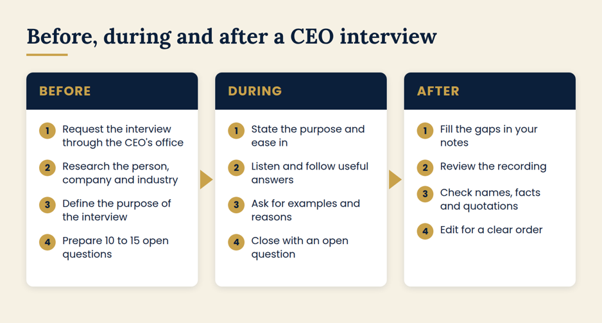
- Request the interview through the CEO’s office and agree the time, format and topic.
- Research the person, the company and the industry.
- Prepare 10 to 15 open questions built around one clear purpose.
- Listen closely, follow useful answers and ask for examples.
- Check every fact and quotation before you publish.
What Makes a CEO Interview Valuable
A useful CEO interview is more than a record of what an executive said. It gives the audience access to the thinking behind the answers. For a business publication, that might be why a company entered a new market, how a difficult decision was made or what a leader learned from an approach that failed. For a publication such as Frontsources, which speaks to founders and senior leaders, that reasoning is usually what readers came for.
The strongest interviews share three habits. The interviewer understands the person, the company and the subject before the conversation starts. The questions go beyond what is already public. And the interviewer listens closely enough to follow an unexpected detail.
A guide written for the Reynolds Center for Business Journalism by executive communications coach Debbi McCullough makes a related point. Reporters should read earlier coverage, press releases and the company website first so they do not retrace the same ground, then ask the CEO to elaborate on points already made. A CEO interview should add something to the public conversation, not repeat a company biography.
How to Request and Set Up the Interview
Most CEO interviews are arranged through an executive assistant or a communications team, so that is where to start if you are wondering how to interview a CEO who is hard to reach. Send a short request that says who you are, where the interview will appear, what you want to discuss and how much time you need. A specific topic makes a yes more likely than a general request for a chat.
Agree the format in advance, whether that is in person, by video, by phone or as written answers. Ask permission before you record and keep your own notes as a backup, because recorders and batteries fail. Both points appear in the University of Florida extension guidance on news interviews. The Reynolds Center guide also advises thanking the person who arranged the interview as well as the CEO.
How to Prepare for a CEO Interview
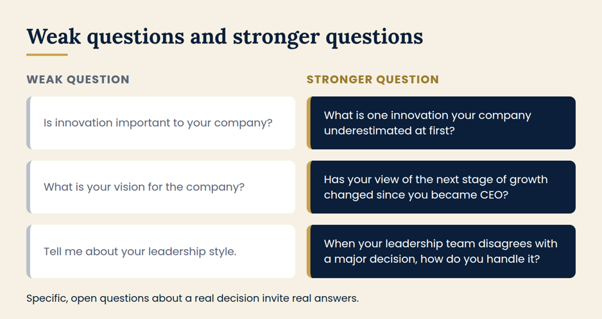
Start with the person. Read previous interviews, speeches, public statements and recent announcements, and note what the CEO has already said. Those topics can still come up, but your question should move the conversation somewhere new. Instead of asking “What is your vision for the company?” you might ask “Has your view of the company’s next stage of growth changed since you became CEO?” The second question invites reflection instead of a prepared statement.
Then learn the company. Review its website, products or services, leadership team and recent news, and go to primary sources when financial or regulatory details matter to the story. The University of Florida guidance adds that it helps to read, watch or listen to the person’s other interviews.
Know the industry well enough that the CEO does not have to explain it to you. With a technology CEO, understand the technology issue. With a manufacturing CEO, know the main market pressures. That lets you ask “Many companies are investing in automation, but where are businesses still underestimating the human side of the change?” instead of asking whether automation matters.
Before you write any questions, finish this sentence. After reading this interview, the audience should understand… The answer might be how the company approached expansion, how the CEO handled a difficult period or how leadership decisions are made. A clear purpose keeps the interview focused.
How to Write Better CEO Interview Questions
The quality of the interview depends on the quality of the questions. A good question is clear, specific and open enough to invite a real answer. The University of Florida guidance advises avoiding yes or no questions and starting with who, what, when, where, why and how.
Compare “Is innovation important to your company?” with “What is one innovation your company underestimated at first?” The first can be answered with a single word. The second gives the CEO something specific to think about.
Questions work best when they point to a decision, a challenge or a change. On strategy, ask which business decision has had the biggest effect on growth. On leadership, ask what becoming CEO changed about the way decisions get made, or which lesson was learned the hard way. On challenges, ask what the CEO got wrong and what changed afterward. On the industry, ask which shift is being underestimated. On a personal level, ask what the CEO believes now that they did not believe five years ago.
Prepare more questions than you need. The University of Florida recommends preparing at least 10 questions. For a 30-minute interview, having 10 to 15 prepared questions gives you enough room to adapt without turning the conversation into a checklist. You will probably use about half. The rest are there for the moment an answer opens a better line of questioning.
How to Ask Follow Up Questions
This is where a prepared interview becomes a conversation. Suppose the CEO says “We had to rethink our approach to expansion.” Do not move to the next question. Ask what made them rethink it. If the answer is still broad, ask whether a particular event changed their view. If they offer a useful example, ask what they did differently afterward.
Simple probes work well. “Why is that?” “Can you tell me more about that?” and “Can you give an example?” will get you further than a clever new question. The University of Florida guidance also describes mirror questions, where you repeat part of the answer so the person explains it further, as in “You say customer expectations changed your strategy. What changed?”
Do not be afraid to leave your list. The same guidance says to deviate from prepared questions when an answer prompts a better one. In practice you work from two lists, the one you prepared and the one that appears during the conversation, and the second is often more valuable.
What to Do When a CEO Gives Short Answers
A short answer can mean the question was too broad, the topic is sensitive or the CEO has answered it many times before. Narrow the question. Instead of “Tell me about your leadership style,” ask “When your leadership team disagrees with a major decision, how do you handle it?” If the answer stays brief, ask for a recent example. You can also reflect part of the answer back, such as “You mentioned that customer expectations changed your strategy. What specifically changed?” The goal is not to push the CEO into saying something dramatic. It is to understand what the answer really means.
How to Structure a 30 Minute CEO Interview
A short interview does not have to feel rushed if the conversation has a shape. Use the first 5 minutes to state the purpose, break the ice and ask an easy question about current priorities. The University of Florida guidance says never to plunge in with the toughest questions. Spend the next 10 minutes on your core questions about strategy, leadership or the subject of your article.
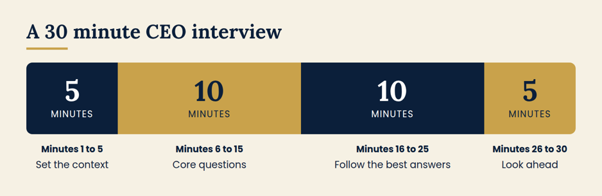
Use the following 10 minutes to follow the most interesting answers, including examples, challenges and decisions, even if that means leaving your list. In the last 5 minutes, look ahead and then ask “Is there anything important about this subject that I have not asked about?” That closing question often brings out something the interviewer did not expect. Treat the structure as a guide, not a script. If the CEO can only give you 10 or 15 minutes, decide in advance which five or six questions matter most.
Where AI Helps and Where It Does Not
Used carefully, AI has a place in how to interview a CEO, mostly before and after the conversation. It can organize public background information, suggest themes, produce variations of a question, transcribe a recording and sort notes into a first draft. It cannot replace the judgment that notices a CEO hesitate, change direction midway through an answer or mention a detail that deserves another question.
Check everything an AI tool produces against the original source, including names, facts, quotations and meaning. Be careful with confidential material, and do not put a recording or transcript into an AI tool without the CEO’s knowledge or against your publication’s policy. Use AI to prepare and organize. Use your own judgment to question, interpret and publish.
How to Edit a CEO Interview for Publication
The work continues after the recording stops. Fill in the gaps in your notes straight away while the conversation is fresh, which is also the University of Florida advice. Then review the recording or transcript for the strongest insights, unexpected answers, useful examples, repeated points and anything that needs checking.
A conversation moves between topics, so a published piece usually needs a clearer order than the interview had. Remove repetition, tighten questions and group related answers while keeping the CEO’s actual meaning. Confirm the spelling of names and job titles, and ask for clarification instead of guessing. The recording remains the reference for every quotation.
Mistakes That Weaken a CEO Interview
Anyone learning how to interview a CEO tends to fall into a few predictable habits, and experienced interviewers do too. Asking questions that a quick search could answer wastes the time of a busy executive. Asking several questions at once, such as why the company entered a market, how the team responded and what was learned, usually earns an answer to only one of them. Leading questions, which suggest the answer you want, are considered unethical by many news writers according to the University of Florida guidance.
Interrupting a useful answer, accepting a polished but empty answer too quickly and forgetting that the reader may know nothing about the company are also common. If an answer sounds good but says little, ask for an example.
What Readers Take Away
Knowing how to interview a CEO is less about having a long list of questions and more about knowing what to do with the answers. A well-prepared interviewer can research the subject, ask questions that open up useful discussion, follow an unexpected point, verify the details and shape the conversation into a story with value for the reader.
For Frontsources, where business stories are built around the experiences, decisions and perspectives of founders and executives, that distinction matters. The aim is not simply to record what a leader says, but to uncover the thinking behind the business and give the audience something worth taking away.
- FAQ
Prepare 10 to 15 for a 30 minute interview. You will probably use about half.
Start with an easy question about their current priorities. Save the tougher questions for later, once they are comfortable.
Ask open questions and follow up with “Why is that?” or “Can you give an example?” Avoid questions that can be answered with yes or no.
Ask for permission before recording. Recording rules can also vary by location and circumstance, so follow applicable law and your publication's policy. Take your own notes as well in case the recording fails.
Yes, to organize research and notes. Always check facts and quotations against the original source yourself.