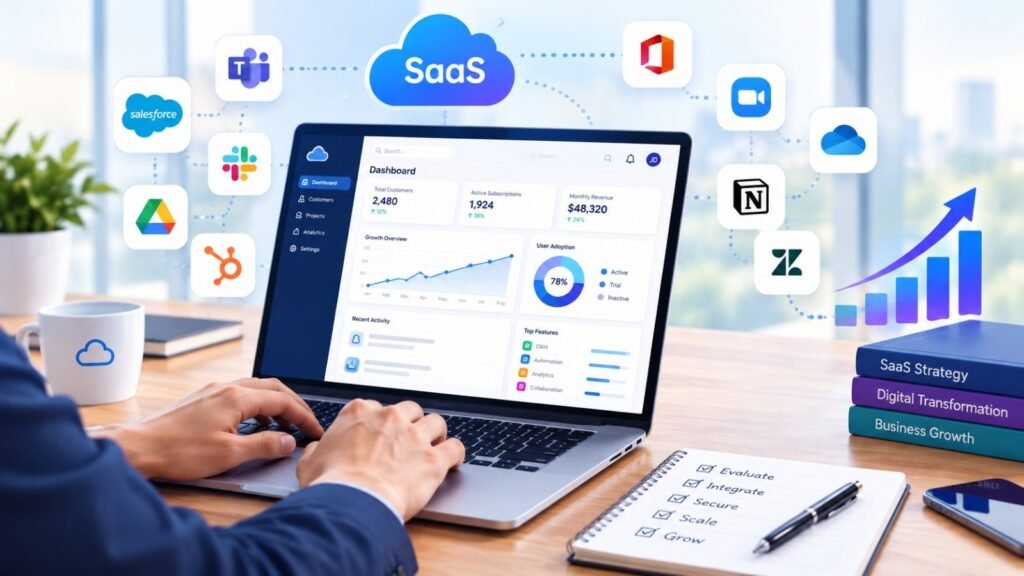
B2B SaaS Buying Guide and Growth Strategies
Start with the problem faced by business buyers.
A B2B SaaS purchase is rarely just a software purchase. It can affect sales processes, employee productivity, customer experience, data security and operating costs.
Explain that buyers should evaluate SaaS based on
- Business requirements
- Integration
- Security
- Total cost
- Scalability
- User adoption
- Vendor support
- Long term value
Then introduce the growth side of the article.
A SaaS company also needs to understand what happens after the sale. Strong onboarding, product value, retention and customer expansion often matter as much as customer acquisition.
What Is B2B SaaS
B2B SaaS is software delivered through the internet that businesses use to manage processes, improve productivity, serve customers or support business decisions.
Examples include software for
- CRM
- Marketing
- Accounting
- Human resources
- Recruitment
- Project management
- Cybersecurity
- Customer support
- Business intelligence
- Collaboration
How to Choose the Right B2B SaaS Solution
This should be one of the main sections.
Start with the business problem
Do not begin with the software features.
Ask
- What problem are we trying to solve
- Who will use the platform
- How frequently will they use it
- What process needs improvement
- What result would justify the investment
Evaluate integration
A SaaS platform should work with the systems already used by the company.
Check integration with
- CRM
- ERP
- HR systems
- Marketing platforms
- Finance software
- Communication tools
- Data platforms
Poor integration can create additional manual work.
Evaluate security
For B2B buyers, security should be part of the buying process rather than a final checklist.
Review
- Data protection
- Access controls
- User permissions
- Data storage
- Compliance requirements
- Vendor security practices
- Backup and recovery
Consider scalability
A solution that works for 20 employees may not work for 500.
Check whether the platform can support
- More users
- More data
- Multiple teams
- Multiple locations
- New workflows
- Future integrations
B2B SaaS Buying Checklist
A simple table can make this section useful for both readers and AI search systems.
| Evaluation Area | What Buyers Should Ask |
|---|---|
| Business value | What problem does it solve |
| Features | Which features are actually required |
| Integration | Does it work with existing systems |
| Security | How is business data protected |
| Pricing | What is the total cost |
| Scalability | Can it support future growth |
| Support | What help is available |
| User experience | Can employees adopt it easily |
| Vendor stability | Is the provider reliable |
| ROI | What measurable business value can it create |
B2B SaaS Pricing and Total Cost
Do not focus only on subscription price.
Explain costs such as
- Subscription fees
- Implementation
- Training
- Integration
- Data migration
- Additional users
- Premium features
- Support
- Internal administration
Practical example
A platform may appear inexpensive because the monthly subscription is low.
However, if implementation requires significant consulting work and employees need extensive training, the real cost can be much higher.
This is why B2B buyers should evaluate total cost of ownership rather than monthly price alone.
B2B SaaS Growth Strategies
Cover practical strategies rather than generic growth advice.
Improve customer onboarding
A customer should reach the first meaningful outcome quickly.
Good onboarding can include
- Clear setup steps
- Product tutorials
- Guided workflows
- Customer support
- Training resources
- Early success milestones
Focus on customer retention
Acquiring customers is expensive.
If customers leave quickly, the company must continuously replace lost revenue.
Retention improves when SaaS companies
- Understand customer needs
- Monitor product usage
- Resolve problems early
- Provide useful support
- Show measurable value
- Improve the product based on customer feedback
Build expansion revenue
Existing customers can become a major source of growth.
Expansion can come from
- Additional users
- Higher plans
- New departments
- Additional products
- Additional services
B2B SaaS Metrics That Actually Matter
1. Customer Acquisition Cost
CAC shows how much a company spends to acquire a customer.
If CAC rises sharply while customer value remains unchanged, the growth model may become difficult to sustain.
2. Customer Lifetime Value
CLV estimates the economic value of a customer over the relationship.
A business needs to understand whether the value generated by a customer justifies the cost of acquiring and serving that customer.
4. Churn Rate
Churn measures how many customers or how much revenue a company loses during a period.
High churn can indicate problems with
- Product value
- Pricing
- Customer support
- Onboarding
- Product fit
5. Monthly Recurring Revenue
MRR tracks recurring subscription revenue.
It helps SaaS companies understand whether predictable revenue is growing or declining.
6. Net Revenue Retention
NRR shows whether existing customers generate more or less revenue over time after expansion and losses.
For mature B2B SaaS companies, this can reveal whether the existing customer base is becoming more valuable.
Recruitment Technology in B2B SaaS
This section should be expanded because recruitment is an important SaaS use case.
B2B SaaS platforms are increasingly used to support recruitment workflows.
They can help with
- Candidate sourcing
- Resume organization
- Candidate matching
- Interview scheduling
- Candidate communication
- Skills analysis
- Recruitment reporting
- Workforce planning
Where technology helps
Recruitment teams often handle large volumes of information.
Software can reduce repetitive work and help recruiters organize candidates more efficiently.
Why human judgment still matters
Technology should support recruiters rather than remove human judgment from hiring.
An automated system may identify candidates based on defined criteria. It may not fully understand
- Career potential
- Communication skills
- Transferable experience
- Leadership ability
- Motivation
- Cultural contribution
- Context behind career changes
A strong recruitment process is therefore
Technology support → Human review → Interview → Human decision
This is especially important for senior and specialist roles where context matters more than keyword matching.
The Future of B2B SaaS
Focus on practical changes rather than predictions without evidence.
More connected software
Businesses increasingly expect SaaS platforms to connect with their existing technology stack.
Greater focus on measurable ROI
Buyers want to know whether software improves
- Revenue
- Productivity
- Cost efficiency
- Customer retention
- Employee performance
More intelligent workflows
Software is moving beyond storing information and helping users complete individual tasks.
Businesses increasingly expect platforms to assist with workflows and decision support.
Stronger security expectations
As SaaS platforms handle more business information, security and governance become more important during vendor selection.
Better personalization
B2B customers increasingly expect software to fit their workflows rather than force every company into the same process.
B2B SaaS Buying Journey
Identify business problem
Define requirements
Research SaaS providers
Compare features and cost
Evaluate security and integration
Run demo or trial
Calculate expected ROI
Make buying decision
Implement and train
Measure business results
Common B2B SaaS Buying Mistakes
- Buying based only on price
- Choosing too many features
- Ignoring integration
- Skipping security evaluation
- Not calculating total cost
- Failing to involve actual users
- Ignoring employee adoption
- Not defining success metrics
- Selecting a vendor without checking support
- Treating implementation as an afterthought
Conclusion
- A SaaS decision is a business decision — the right buy starts with the problem, not the feature list.
- Integration, security, and total cost determine whether a platform still works eighteen months in, not just on demo day.
- Retention and expansion are where the real ROI shows up — acquisition is just the entry point.
- FAQ
B2B SaaS is internet based software designed to help businesses manage processes, improve productivity, support customers or make decisions.
Businesses should evaluate the problem being solved, required features, integration, security, pricing, scalability, support and expected ROI.
Important metrics include CAC, CLV, churn, MRR and NRR. These metrics help companies understand acquisition cost, customer value, recurring revenue and retention.
Key areas include connected software, intelligent workflows, measurable ROI, stronger security and greater personalization.
They can improve onboarding, monitor customer usage, respond to problems early, provide useful support and continuously demonstrate product value.
AI can improve automation, analysis, personalization and workflow support. However, its value depends on whether it solves a real business problem and produces measurable results.