
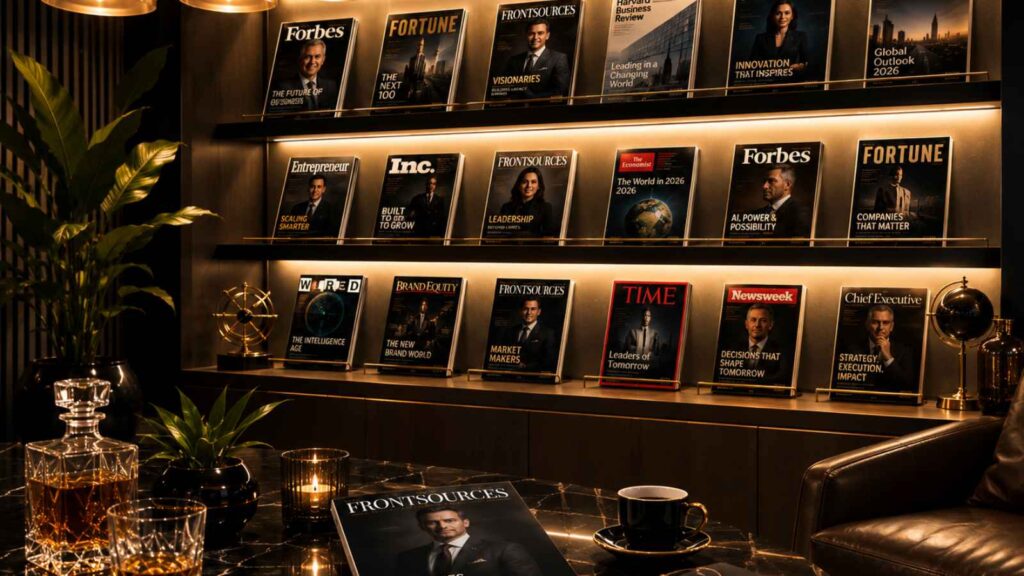
Luxury Magazine Trends 2026: How Premium Digital Publishing Evolves
According to Bain & Company, nearly 70% of luxury purchases are now digitally influenced — yet most luxury publications are still designed around assumptions formed in the print era. That gap between where luxury consumers actually live and where luxury media continues to operate is the defining tension of premium publishing in 2026, and the brands closing it fastest are not the largest or the oldest. They are the most editorially intelligent.
The modern luxury publication has evolved far beyond its origins as a glossy showcase of aspiration. It has become a sophisticated media ecosystem where storytelling, technology, design, and consumer psychology intersect in real time — a cultural instrument as much as a commercial one. Across fashion, business, leadership, and lifestyle media, the most influential luxury magazine trends 2026 conversations are no longer centred around print circulation or celebrity cover placement. They are focused on a more fundamental question: how do premium publications create genuine emotional resonance in an increasingly fragmented, algorithmically driven digital environment?
For luxury brands, editorial platforms are rapidly becoming strategic instruments of long-term influence rather than traditional advertising channels. For readers, expectations have shifted just as dramatically. Affluent audiences now demand experiences that feel curated, intellectually rigorous, and deeply aligned with their identity — not merely beautiful. According to research from McKinsey & Company, younger affluent consumers are reshaping the luxury market with entirely different expectations around authenticity, sustainability, and personalisation, and those expectations are flowing directly into how they evaluate and engage with the publications they choose to trust.
The future of luxury publishing belongs to platforms capable of combining cultural intelligence with digital innovation. That shift is already well underway, and its implications are significant for every publisher, brand, and editorial leader operating in the premium space.
The End of Passive Luxury Content: Why Immersion Wins
For decades, luxury media operated through aspiration-driven distance. Publications presented a polished, elevated world that readers admired from afar — a world of well-lit surfaces, carefully controlled brand imagery, and editorial authority that was never questioned and rarely explained. That model sustained itself for generations. In 2026, it is comprehensively obsolete.
Modern audiences, particularly Gen Z luxury consumers, are not looking merely to observe premium lifestyles from a respectful distance. They want participation, immersion, and emotional relevance — content that feels like it was created specifically for them rather than broadcast at a demographic. The most successful luxury lifestyle magazine trends now revolve around building ecosystems rather than static publications, creating environments where readers return not out of habit but out of genuine intellectual appetite.
This shift mirrors broader changes in high-net-worth consumer behaviour. Sophisticated readers have become more selective about where they invest their attention, and they are no longer impressed by excess alone. They respond to refinement, clarity, and thoughtful editorial construction — content that respects their intelligence as much as their taste. Digital magazine trends 2026 increasingly reflect this reality, with leading publications moving toward immersive interfaces, cinematic storytelling, intelligent personalisation, audio-led editorial, and premium community engagement as the new architecture of reader experience.
The rise of the quiet luxury trend 2026 is the most visible expression of this cultural transition. Minimalism, restraint, craftsmanship, and emotional depth are replacing overt visual extravagance across branding, retail, and publishing simultaneously. Publications like Monocle and Vogue Business have successfully adapted to this shift by building experiences that feel intellectually curated rather than algorithmically produced — and their reader loyalty reflects the long-term commercial value of that editorial discipline. In luxury publishing, as in luxury branding, restraint has become the most sophisticated signal of authority.
AI in luxury publishing: from automation anxiety to editorial intelligence
The early conversation around AI in luxury publishing was dominated by a single anxiety — that automation would replace the human creativity at the heart of editorial excellence. That conversation has matured significantly, and the most forward-thinking publishers have moved well beyond it.
Today, leading luxury media organisations are using artificial intelligence not as a replacement for creative judgment but as a precision instrument for audience intelligence, editorial strategy, and hyper-personalised luxury content delivery. The distinction matters enormously. AI deployed in service of editorial vision produces outcomes that feel more relevant, more timely, and more deeply connected to individual reader interests. AI deployed as a substitute for editorial vision produces content that is technically competent and emotionally empty — a distinction that luxury audiences, with their highly developed cultural literacy, detect almost immediately.
In operational terms, publishers are using AI to refine audience segmentation, build predictive content strategies, power recommendation systems, analyse engagement patterns at granular levels, and personalise editorial delivery in ways that would be logistically impossible through manual curation alone. For premium publishers, this matters because affluent audience engagement now depends critically on relevance. Readers who encounter content ecosystems that appear to anticipate their interests rather than forcing them to search through information excess respond with significantly deeper engagement and stronger retention. According to McKinsey & Company, businesses integrating AI into creative and marketing operations are reporting up to 40% improvements in content engagement performance when human editorial oversight is maintained throughout the process.
The publishers succeeding in this transformation understand a principle that technology alone cannot teach: an algorithm may optimise distribution, but it cannot replicate editorial instinct, cultural sensitivity, or narrative depth. That balance between machine intelligence and human creativity is becoming central to leadership media trends 2026 discussions across the world’s most influential media organisations — and it will define which luxury publishing platforms earn genuine long-term authority and which ones achieve merely efficient content production.
Luxury brand storytelling: the shift from messaging to meaning
One of the most consequential luxury media trends reshaping 2026 is the movement away from transactional messaging toward emotionally intelligent, psychologically sophisticated storytelling. This shift is not cosmetic. It reflects a structural change in how affluent consumers relate to luxury brands — and by extension, to the publications that represent them.
Luxury consumers today are among the most media-literate audiences in the world. They instantly recognise performative branding, manufactured exclusivity, and overproduced visual language for what it is — and they move on without ceremony. What resonates instead is authenticity paired with sophistication: storytelling that communicates genuine conviction rather than constructed aspiration, and editorial positioning that treats the reader as an intellectual equal rather than a demographic target.
This evolution has transformed luxury brand marketing 2026 strategies across industries ranging from fashion and hospitality to technology and automotive. Premium storytelling has moved its focus decisively away from products and toward identity, emotional aspiration, cultural alignment, craftsmanship narrative, and authentic personal values. Hermès continues to maintain its position as perhaps the world’s most influential luxury brand not through aggressive visibility or campaign frequency, but through controlled storytelling, absolute consistency, and a perceived integrity that decades of editorial discipline have made virtually unassailable. Similarly, Loro Piana has built formidable global demand through subtle positioning that aligns with quiet luxury aesthetics so precisely that the brand has become synonymous with the aesthetic itself.
Luxury publishing is adopting identical principles. The strongest editorial platforms today do not compete for attention through sensationalism, controversy, or the sheer volume of content published. They build long-term credibility through insight depth, visual intelligence, refined narrative construction, and strategic editorial positioning that makes every piece of content feel like it was worth the reader’s time. This matters with particular intensity for executive readership segments, where time has become the scarcest and most fiercely protected resource. Decision-makers at the highest levels of business and culture are no longer willing to trade their attention for content that delivers noise rather than perspective — and the publications that understand this are building the audiences that matter most.
Quiet luxury trend 2026: how restraint became the new editorial authority
Quiet luxury is not a passing aesthetic moment. It is a fundamental repositioning of what authority looks and feels like in premium culture — and its implications for luxury digital publishing are significant and durable.
The quiet luxury movement began as a fashion conversation but has migrated steadily into editorial design, brand communication, hospitality, and now publishing strategy. At its core, it represents a rejection of conspicuous consumption in favour of something more nuanced: the confidence to communicate value through quality, restraint, and depth rather than volume and visibility. For luxury publications, this translates into slower storytelling, elevated visual pacing, understated aesthetics, and intentional content architecture — editorial choices that signal respect for the reader’s intelligence rather than anxiety about losing their attention.
Publications that have built their identities around quiet luxury principles are demonstrating measurably stronger reader loyalty and brand association than those still competing through visual intensity. Monocle’s typographically restrained, editorially rigorous approach has earned it a global audience of highly influential readers who are disproportionately valuable to the advertisers and brands seeking access to them. Kinfolk built an international readership of extraordinary loyalty through an editorial aesthetic that treats stillness, craftsmanship, and slowness as aspirational values rather than liabilities in a fast-moving content environment. These are not accidents of taste. They are the results of deliberate, consistent editorial discipline applied over years of publication.
Sustainable luxury media is closely connected to this aesthetic shift. Audiences who are drawn to quiet luxury values tend to be equally drawn to publications with genuine commitments to purpose, environmental responsibility, and editorial integrity — not as marketing positions but as operational realities. The convergence of quiet luxury aesthetics and sustainable editorial values is creating a new category of premium publication that attracts exactly the kind of deeply engaged, values-aligned readership that luxury brands most want to reach.
Gen Z luxury consumers and the new definition of premium media
No demographic is reshaping the future of luxury publishing more decisively than Gen Z — and the challenge they represent for traditional premium publishers is more fundamental than a simple shift in platform preference or content format.
Unlike previous generations of luxury consumers, younger affluent audiences approach premium culture through an entirely different evaluative framework. Status signalling through brand recognition alone carries significantly less weight than it once did. Instead, Gen Z luxury consumers prioritise cultural relevance, authentic sustainability commitments, genuine inclusivity, digital sophistication, and emotional authenticity — and they apply these criteria to the publications they choose to engage with just as rigorously as they apply them to the brands they choose to purchase. According to McKinsey, Gen Z consumers are expected to represent a major share of global luxury spending growth over the coming decade, making their editorial expectations not a niche concern but the central challenge of luxury publishing strategy.
The media consumption behaviour of this generation compounds the challenge. They move fluidly across short-form video, long-form editorial, podcasts, immersive platforms, newsletters, and creator-led ecosystems within a single day — and they expect the premium publications they value to meet them across all of these environments without sacrificing the editorial quality that justified their trust in the first place. This explains why luxury publishing innovation 2026 strategies increasingly involve sophisticated multi-platform storytelling rather than isolated magazine experiences anchored to a single format or publication rhythm.
The publications succeeding with this audience understand a balance that is genuinely difficult to achieve: speed without superficiality, personalisation without intrusion, and premium experience without the kind of exclusionary pretension that younger luxury consumers find both unconvincing and unappealing. Achieving that balance requires editorial intelligence rather than simply editorial production — and it is why the quality of thinking behind a publication’s strategy matters more in 2026 than at any previous point in the history of luxury media.
Indian luxury media growth: local authority building global influence
India’s growing role in global luxury media is one of the most significant and least widely acknowledged developments in premium publishing — a transformation that is already reshaping the geography of editorial influence in ways that will become impossible to ignore over the next five years.
India’s expanding affluent class, rapidly evolving entrepreneurial ecosystem, and digitally connected consumer base are creating entirely new opportunities for premium media brands with the cultural intelligence to serve them well. According to Deloitte, India is projected to become one of the world’s fastest-growing luxury markets over the coming decade — a projection that is already visible in the accelerating presence of global luxury brands across Indian cities and the rising sophistication of Indian consumer expectations across every luxury category.
The rise of luxury media India global conversations within international publishing reflects a broader and more important shift: the decentralisation of editorial influence. Cultural leadership in premium media no longer belongs exclusively to the traditional Western media capitals that defined luxury publishing for most of the twentieth century. Indian entrepreneurs, luxury founders, designers, and business leaders are gaining genuine global visibility across technology, fashion, leadership, hospitality, and premium consumer sectors — and they are doing so through editorial platforms and media ecosystems that understand their stories from the inside rather than observing them from a distance.
Indian publications like India Today, Verve, Condé Nast Traveller India, and Outlook Business have been building sophisticated editorial design systems and content strategies that respond specifically to the aesthetic sensibilities, cultural references, and intellectual expectations of Indian audiences while remaining globally legible and internationally credible. Platforms like Frontsources are already navigating this intersection — treating premium storytelling not as a content function but as the primary instrument through which editorial authority is built, sustained, and trusted by the leaders who read it. The next wave of luxury publishing influence will emerge from brands that understand both regional authenticity and international sophistication with equal depth — and India is producing those brands with increasing speed and confidence.
Luxury media investment strategy: why brands are becoming publishers
Luxury brands are fundamentally reevaluating how they invest in visibility — and the shift underway is more structural than cyclical.
Traditional advertising still plays a role in luxury brand communication, but the most sophisticated global luxury brands are now prioritising owned editorial ecosystems, strategic media partnerships, and immersive content platforms over purely campaign-driven exposure. This reflects a deeper change in how premium brands understand the relationship between investment and trust. LVMH, Kering, and Richemont have all made significant investments in editorial content capabilities that sit alongside rather than inside their traditional marketing functions — recognising that audience trust accumulated through consistent, high-quality editorial content creates brand equity that paid advertising cannot replicate at any budget level.
Modern luxury brands understand that audience trust compounds over time in ways that campaign-driven visibility does not, and their investment strategies are increasingly structured around this reality. Resources are moving toward long-term storytelling, editorial collaborations with credible independent publishers, experiential luxury trends that create memorable brand encounters, branded publishing initiatives, and high-value consumer engagement that treats readers as participants rather than targets. The distinction between publisher and brand is blurring in both directions simultaneously — luxury brands are behaving more like media companies, and media companies are becoming architects of cultural experience rather than simply distributors of editorial content.
This convergence is reshaping the luxury publishing industry itself in ways that create significant opportunities for independent premium platforms. As global luxury brands seek editorial partners with genuine audience authority and cultural credibility, the publications that have invested consistently in quality, independence, and reader trust find themselves in a position of influence that their scale alone would never have justified. Immersive luxury content, deeply researched editorial, and editorially independent perspectives are becoming valuable commodities in a market where branded content alone can no longer do the work that authentic editorial trust once performed.
Three decisions every luxury publisher must make in 2026
The future of luxury digital publishing will not be determined by which organisations have access to the most sophisticated technology or the largest editorial budgets. It will be determined by which publishers develop the clearest understanding of what their audiences need — and the editorial discipline to deliver it with consistency, intelligence, and genuine cultural conviction.
Three strategic decisions separate the luxury publications building durable authority from those producing beautiful but ultimately forgettable content. The first is to invest in editorial depth over content frequency — accepting that one piece of content that earns genuine engagement, repeat reading, and word-of-mouth recommendation among influential readers creates more long-term brand value than ten pieces of adequate content that are consumed once and forgotten. In luxury publishing, as in luxury branding itself, the scarcity of genuine quality is the most powerful signal of value.
The second decision is to treat AI as an accelerant for human editorial creativity rather than a substitute for it — using machine intelligence to understand audiences better, deliver content more precisely, and execute editorial vision more efficiently, while ensuring that the vision itself, the cultural sensitivity, the narrative depth, and the emotional intelligence remain irreducibly human. The publications that will define the next era of premium media are those where AI makes editors more capable, not redundant.
The third decision is to build audience trust as a long-term brand infrastructure investment rather than a campaign metric — recognising that the loyalty of a deeply engaged, intellectually demanding luxury audience is not something that can be bought or manufactured, but can only be earned through years of consistent editorial excellence. The publications that have made this investment patiently are discovering that their audience relationships are their most valuable and least replicable competitive advantage.
The future of luxury publishing is not about more complexity, more content, or more technological sophistication. It is about more meaning — delivered with more precision, more cultural intelligence, and more genuine respect for the time and attention of the readers who matter most.
AI-driven personalisation, immersive storytelling, quiet luxury aesthetics, and multi-platform publishing are redefining luxury magazine trends in 2026. Premium media is shifting from print-first to experience-first.
AI helps luxury publishers personalise content, optimise audience engagement, and improve editorial efficiency. The strongest brands use AI to enhance human creativity—not replace it.
Quiet luxury reflects modern consumer demand for refinement, minimalism, and authenticity. In publishing, it signals premium quality through elegant design and thoughtful storytelling.
Gen Z expects authenticity, sustainability, and digital-first experiences from luxury brands and publications. Their preferences are reshaping how premium media is created and distributed.
Owned editorial platforms help luxury brands build long-term trust, authority, and deeper audience relationships. Editorial influence now delivers stronger value than traditional advertising alone.