
Executive Networking Strategies
Executive networking is the practice of building a small set of relevant relationships with senior leaders, so that knowledge, introductions and opportunities move in both directions. It has little to do with the size of your contact list. For B2B leaders, the strongest executive networking strategies are strategic introductions, small roundtables, selective events and steady follow up, judged by the conversations they create.
This guide explains how executives network, where to focus first and how to tell whether the effort is working. It is written for CEOs, founders and senior leaders who want results from networking without filling the calendar.
What Is Executive Networking?
Executive networking is the deliberate building of professional relationships with other business leaders, investors, advisers, partners and industry voices. The aim is mutual value. You share what you know, others share what they know, and opportunities follow as trust grows.
It differs from general networking in three ways. The group is smaller and more senior. The conversations are about business problems, not job titles. And the payoff is slower but larger, because partnerships, referrals and investor interest depend on trust built over time.
Why Executive Networking Matters in B2B
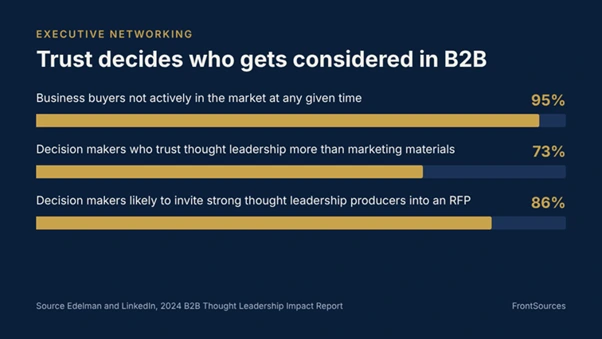
B2B decisions involve large budgets and shared accountability, so buyers lean on people they trust. The 2024 B2B Thought Leadership Impact Report from Edelman and LinkedIn notes that, at any given time, about 95 percent of business buyers are not actively in the market. Relationships formed before a need appears decide who gets considered when one does.
Expertise builds that trust. In the same research, 73 percent of decision makers said an organization’s thought leadership is a more trustworthy basis for judging its capabilities than its marketing materials. And 86 percent said they would be likely to invite organizations that produce high quality thought leadership into a request for proposal process. When an executive shares real experience, buyers listen.
Harvard Business Review points the same way. In How Leaders Create and Use Networks, Herminia Ibarra and Mark Hunter followed 30 managers for two years through a leadership transition. They found three forms of networking at work, operational, personal and strategic, and noted that almost all of the managers underused the strategic form. That is why executive networking strategies need a strategic layer, not only an operational one.
The Three Networks Every Executive Needs
Each network has a different job. Operational networking comes naturally to most leaders. The strategic network is the one most often neglected.
| Network | Purpose | Who Is in It | A Practical Move |
|---|---|---|---|
| Operational | Get current work done | Your team, board, suppliers and key clients | Hold regular check ins with the people your plans depend on |
| Personal | Learn and gain perspective | Peers, mentors, associations and alumni | Join one executive peer group outside your own sector |
| Strategic | Shape direction and find new business | Investors, analysts, partners and industry leaders | Make or request one useful introduction each month |
Executive Networking Strategies That Create Business Value
Start with one question. Who should I build a relationship with, and why? If you cannot answer in a sentence, the meeting can wait. Relationship building for B2B leaders is about quality over quantity, and these B2B networking strategies work because each one starts with relevance.
Make Strategic Introductions
A relevant introduction is worth more than dozens of cold contacts. Before connecting two people, be clear on the shared business interest that gives them a reason to talk. Explain it in two lines, make the introduction and step back. People remember who connected them to something useful.
Host or Join Executive Roundtables
Small, curated groups work better than large rooms because everyone speaks. Choose one topic, such as a market shift, a regulatory change or a hiring problem, and invite only people who can add something. Quality of discussion matters more than headcount. This is curated executive networking in its simplest form.
Share Knowledge Instead of Pitching
Executives who publish useful ideas through articles, interviews, panel talks and research give people a reason to reach out. Executive interview features, such as those on FrontSources, let leaders explain their decisions and lessons in their own words to a wider business audience. Reading one of the better CEO interviews is also a quick way to see how other leaders think.
Build Relationships Outside Your Sector
Other industries show you problems before they reach yours. The Center for Creative Leadership notes in its research on leader networks that a large network is not necessarily a good one, because large networks can be draining. It also describes open networks, where the people you know are not all connected to each other, as a source of diverse input. Associations, alumni groups and executive peer groups outside your company help you build exactly that. A business magazine for executives is another good place to see who is shaping your industry.
Use LinkedIn With a Purpose
Comment on the posts of people you want to know, with something specific to add. Move promising conversations to a call or a meeting. A connection request without a reason seldom starts a relationship.
Which Executive Networking Format Fits You
No single format suits every leader. Match the format to the goal and the time you can spare
| Format | Best For | Typical Effort | Watch Out For |
|---|---|---|---|
| Executive Roundtable | Deep peer conversation on one topic | Medium, a few hours | Inviting people who cannot add value |
| Industry Event | Meeting several new people quickly | High, often a full day | Collecting cards without follow up |
| Peer Group | Ongoing advice from leaders in similar roles | Low and regular | Staying inside one sector |
| Interviews and Articles | Building credibility with a wider audience | Medium, a one time effort | Sounding promotional |
| LinkedIn Conversations | Warming up contacts before a meeting | Low, a few minutes a day | Generic connection requests |
How to Network as an Executive
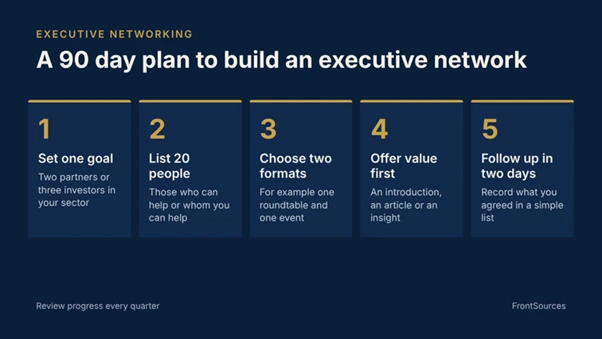
Here is how to build an executive network in five steps, using the strategies above as a 90 day plan.
- Set one goal for the next 90 days, such as finding two strategic partners or meeting three investors in your sector.
- List 20 people who could help with that goal or whom you could help.
- Choose two formats from the table above, for example one roundtable and one event.
- Offer something first, such as an article, an introduction or a market observation.
- Follow up within two days and note what you agreed.
Here is an illustration, not a case study. Imagine a founder of a logistics software company who wants two channel partners within six months. She lists 20 relevant people, hosts one small roundtable on supply chain visibility with six guests and introduces two attendees to each other. Guests start asking about partnerships because she offered value before asking for anything. The result comes from relevance and generosity, not from reach.
How to Network at Executive Events
Executive networking events reward preparation. Read the agenda, study the speakers and the attendee list where one is shared, and decide who you want to meet and why. Prepare one question about their business, not a pitch about yours. Aim for a few real conversations instead of many brief ones, then send a short message the next day that refers to something specific you discussed. Follow up is where most of the value is kept or lost.
Networking Strategies for CEOs and Founders
CEOs and founders have little spare time and few peers who face the same decisions. The best networking tips for founders reflect that.
- Block a fixed weekly slot for networking so it does not depend on spare time.
- Build a circle of other CEOs and founders, who understand your decisions better than most people.
- Give before you ask. Share a lesson, an introduction or a contact.
- Be selective. Two or three communities done well beat ten joined and ignored.
- If your company is new, start with customers, advisers and other founders, then widen the circle.
How to Measure Executive Networking
Contact counts and follower numbers do not show whether networking works. Look for signals that relationships are turning into business conversations.
| Signal | What It Shows |
|---|---|
| Qualified Introductions | The network is relevant |
| Business Conversations | Visibility is creating interest |
| Partnership Inquiries | Credibility is creating opportunity |
| Speaking Invitations | Industry authority is growing |
| Media Opportunities | Outside recognition is increasing |
| Recruitment Interest | Your reputation attracts talent |
Record these monthly in a simple list and review them each quarter. The measure that matters most is whether the right people are starting meaningful conversations. For a wider view of measurement in business growth, read our guide on marketing ROI beyond traditional attribution.
Mistakes to Avoid
Even well planned executive networking strategies fail when leaders fall into these habits.
- Treating networking as selling.
- Attending events without a clear purpose.
- Collecting contacts and never following up.
- Reaching out only when you need something.
Conclusion
Executive networking strategies work when they are selective, useful and consistent. Strategic introductions, small roundtables, well chosen events and shared knowledge build trust, and trust is what B2B decisions rest on. Start with one goal, a short list of people and a simple way to measure the result.
FrontSources is a digital business magazine for founders, CEOs and professionals, publishing executive interviews, leadership stories and business trends. You can learn more on the About Us page, see how FS Elites focuses on influential business leaders.
Sources
- Edelman and LinkedIn, 2024 B2B Thought Leadership Impact Report
- Edelman, Thought leadership gets B2B buyers back into the game
- Herminia Ibarra and Mark Hunter, How Leaders Create and Use Networks, Harvard Business Review, January 2007
- Center for Creative Leadership, research paper on leader networks
- FAQ
Strategic introductions, small roundtables, selective events, knowledge sharing and steady follow up. Pick two or three and measure the conversations they create.
Set a clear goal, list the people who matter to it and offer value before you ask for anything. Follow up within two days of every meeting.
CEOs network through peer groups, curated roundtables, selected events and trusted introductions. A fixed weekly slot keeps it consistent.
Study the agenda and attendees first, then aim for a few meaningful conversations. Send a specific follow up message the next day.
Track qualified introductions, business conversations, partnership inquiries and speaking invitations. These show whether relationships are turning into opportunity.