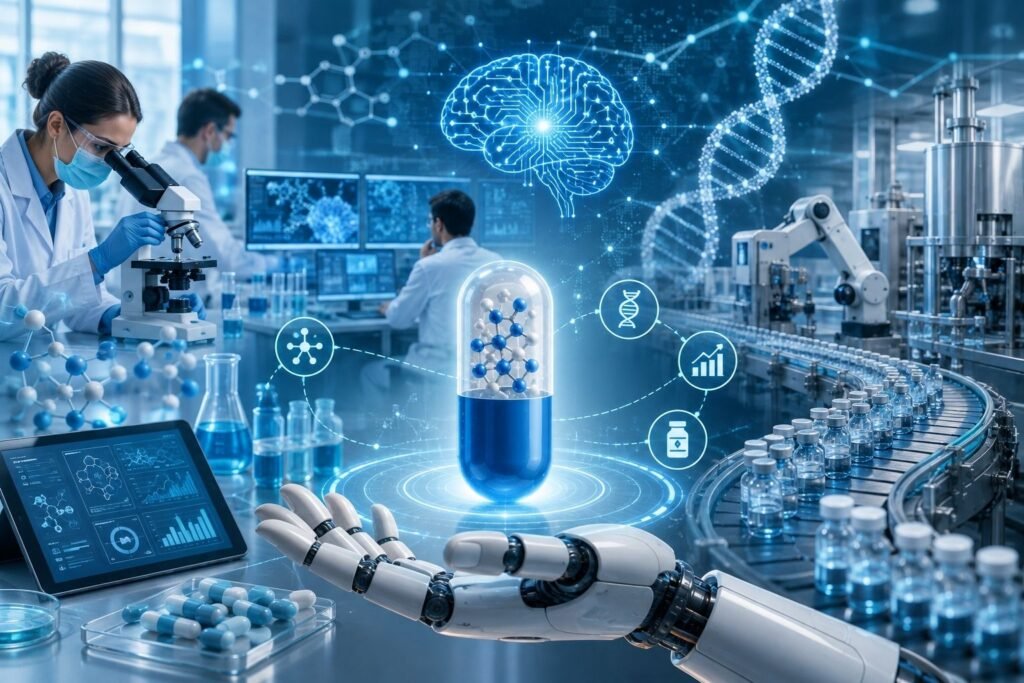
How AI Is Reshaping the Pharmaceutical Industry
The Pharmaceutical Industry is undergoing a significant technological transformation, and it’s worth being precise about what’s actually changing. Artificial intelligence is increasingly used across research, drug discovery, clinical development, manufacturing, and business operations — not because AI makes scientific decisions, but because it can process volumes of scientific and operational data far faster than manual review, freeing scientists and clinicians to spend their judgment where it matters most.
From AI-Powered Drug Discovery to AI Pharmaceutical Manufacturing, the use of artificial intelligence is expanding across the pharmaceutical value chain. Technologies such as machine learning, deep learning, natural language processing, and generative AI are creating new opportunities for pharmaceutical research and development — and the organizations getting genuine value from these tools are the ones that understand precisely where AI’s contribution ends and scientific validation begins.
The Growing Role of AI in the Pharmaceutical Industry
The traditional pharmaceutical development process is complex, time-consuming, and resource-intensive by nature — industry figures commonly cite an average of 10 to 15 years and well over $2 billion to bring a single new drug from initial discovery to market approval, with roughly 90% of candidates that enter clinical trials never reaching patients. AI doesn’t eliminate that risk profile, but it can support different stages by analyzing large and complex datasets more efficiently than manual review allows.
Key AI applications in pharmaceutical industry include drug target identification, molecule design, drug candidate screening, drug repurposing, clinical trial optimization, scientific data analysis, manufacturing process optimization, quality monitoring, supply chain planning, pharmacovigilance, and scientific literature analysis.
AI-Powered Drug Discovery Is Transforming Early Research
AI-Powered Drug Discovery is one of the most significant applications of artificial intelligence in the Pharmaceutical Industry, and it’s also one of the few areas where a concrete, publicly documented case study now exists rather than just a theoretical promise.
Insilico Medicine’s generative AI platform identified TNIK as a novel biological target for idiopathic pulmonary fibrosis (IPF) and then designed a small-molecule compound against that target — synthesizing fewer than 80 physical molecules along the way, compared to the hundreds or thousands typically screened in conventional discovery programs. The process took the program from initial hypothesis to preclinical candidate nomination in approximately 18 months, versus the multi-year timelines typical of conventional target-to-candidate work. The resulting compound, rentosertib, has since progressed through Phase I and Phase IIa trials and, as of 2026, is advancing into Phase III — making it one of the most closely watched real-world proof points for AI-driven drug discovery to date.
That example is worth sitting with, because it illustrates both the promise and the limits accurately: the AI compressed the discovery timeline meaningfully, but the compound still had to go through the same multi-phase human clinical trial process, the same regulatory review, and the same safety scrutiny as any other drug candidate. AI can assist researchers by analyzing protein structures, biological pathways, molecular properties, chemical compounds, genomic information, scientific literature, and experimental results — machine learning models may help identify patterns and prioritize promising areas for further investigation, but AI predictions still require experimental testing and scientific validation before they mean anything clinically.
AI in Drug Development: Improving the Development Process
The role of AI in Drug Development extends beyond the early discovery phase. Potential applications include predicting selected molecular properties, supporting formulation development, analyzing preclinical data, identifying potential safety signals, supporting trial planning, and optimizing development workflows.
Pharmaceutical development remains dependent on rigorous research, testing, regulatory requirements, and expert scientific judgement at every stage — an AI model flagging a potential safety signal in preclinical data, for instance, is a prompt for a toxicologist to investigate further, not a conclusion a development team can act on unreviewed.
Generative AI in Pharma
Generative AI in Pharma is receiving increasing attention because of its ability to create new content or generate potential outputs based on patterns learned from data — the Insilico Medicine example above is a direct case of generative AI designing a novel molecular structure, not simply screening existing ones.
Potential applications include designing molecular structures, generating scientific content, summarizing research information, supporting knowledge management, analyzing scientific literature, and assisting with documentation. Accuracy, transparency, data governance, and human oversight are particularly important in this highly regulated industry — a generative model that fabricates a plausible-sounding but incorrect summary of a safety study is a materially different problem in pharma than in most other industries, given what’s downstream of that document.
AI in Pharmaceutical Research
AI in Pharmaceutical Research can support scientists by helping them process information from multiple sources faster than manual literature review would allow. AI-based systems may help with literature review, data classification, pattern identification, research hypothesis generation, knowledge discovery, and data integration.
The practical value here compounds over time: a researcher using an AI literature-analysis tool to scan thousands of papers for a specific biological pathway isn’t replacing their own expertise — they’re spending less time on manual search and more time evaluating the handful of genuinely relevant findings the tool surfaces.
AI Clinical Trial Optimization and Patient Recruitment
Clinical trials require careful planning, participant recruitment, data collection, monitoring, and analysis — and patient recruitment specifically is one of the most persistent bottlenecks in the entire drug development timeline, since a poorly matched or slow-to-enroll trial can delay a promising drug candidate by months regardless of how strong its underlying science is.
AI Clinical Trial Optimization can support this directly by matching patient records against trial eligibility criteria far faster than manual chart review, identifying candidate sites with the right patient population density, and flagging enrollment trends that suggest a trial is falling behind target. For a rare-disease trial like the IPF program referenced earlier — which affects a relatively small, geographically dispersed patient population — this kind of AI-assisted matching can materially shorten the search for eligible participants across multiple trial sites.
What AI does not do, and should not be positioned as doing, is make the actual recruitment or enrollment decision. Informed consent, final eligibility judgment, and ethical oversight remain the responsibility of investigators and institutional review boards — an AI system can surface that a patient’s records appear to match trial criteria, but it has no standing to obtain consent, weigh a borderline exclusion criterion against a patient’s specific clinical picture, or account for context that isn’t captured in structured data. AI should support — not replace — clinical researchers, investigators, and appropriate regulatory oversight, and the trials that use these tools most successfully are the ones where investigators treat AI-flagged matches as a starting shortlist to review, not an enrollment decision to rubber-stamp.
AI Clinical Trial Optimization and Patient Recruitment
Clinical trials require careful planning, participant recruitment, data collection, monitoring, and analysis — and patient recruitment specifically is one of the most persistent bottlenecks in the entire drug development timeline, since a poorly matched or slow-to-enroll trial can delay a promising drug candidate by months regardless of how strong its underlying science is.
AI Clinical Trial Optimization can support this directly by matching patient records against trial eligibility criteria far faster than manual chart review, identifying candidate sites with the right patient population density, and flagging enrollment trends that suggest a trial is falling behind target. For a rare-disease trial like the IPF program referenced earlier — which affects a relatively small, geographically dispersed patient population — this kind of AI-assisted matching can materially shorten the search for eligible participants across multiple trial sites.
What AI does not do, and should not be positioned as doing, is make the actual recruitment or enrollment decision. Informed consent, final eligibility judgment, and ethical oversight remain the responsibility of investigators and institutional review boards — an AI system can surface that a patient’s records appear to match trial criteria, but it has no standing to obtain consent, weigh a borderline exclusion criterion against a patient’s specific clinical picture, or account for context that isn’t captured in structured data. AI should support — not replace — clinical researchers, investigators, and appropriate regulatory oversight, and the trials that use these tools most successfully are the ones where investigators treat AI-flagged matches as a starting shortlist to review, not an enrollment decision to rubber-stamp.

Benefits of AI in Pharmaceutical Industry
The potential benefits of AI in pharmaceutical industry include faster data analysis, improved research efficiency, better decision support, potentially faster drug discovery, improved manufacturing efficiency, and enhanced clinical trial operations.
It’s worth explaining what ‘faster’ actually means in context rather than treating it as a marketing claim: in the Insilico Medicine case, the compression was specifically in the target identification-to-preclinical-candidate phase — roughly 18 months against a conventional benchmark often cited in years, not decades. That’s a genuinely significant reduction, but it applies to one phase of a much longer development and regulatory process; the benefits achieved will always depend on the specific use case, implementation quality, available data, and organizational capabilities, not a single blanket percentage that applies industry-wide.
AI for Pharmaceutical Companies: Beyond Research
The use of AI for Pharmaceutical Companies is not limited to laboratories and manufacturing facilities. AI technologies can also support supply chain planning, demand forecasting, document management, knowledge management, regulatory information management, customer and stakeholder support, and internal process automation.
A successful AI strategy should consider business objectives, scientific requirements, data quality, regulatory obligations, cybersecurity, privacy, model validation, and human oversight — treating AI adoption as a scientific and regulatory decision as much as a technology one is what separates organizations that get durable value from those that end up with an underused pilot project.
AI Applications in Pharmaceutical Industry Across the Value Chain
AI is increasingly being explored across different parts of the Pharmaceutical Industry, and the table below summarizes both AI’s contribution and where human or scientific judgment remains essential at each stage.
| Value Chain Stage | What AI Contributes | What Still Requires Human/Scientific Judgment |
|---|---|---|
| Drug discovery | Pattern recognition across molecular and genomic data, faster candidate prioritization | Experimental validation, biological plausibility review |
| Drug development | Preclinical data analysis, formulation modeling | Toxicology assessment, regulatory submission judgment |
| Clinical trials | Patient recruitment matching, trial data monitoring | Informed consent, eligibility judgment, ethical oversight |
| Manufacturing | Predictive maintenance, anomaly detection, process forecasting | Batch release decisions, quality sign-off |
| Pharmacovigilance | Faster scanning of adverse event reports and literature | Causality assessment, regulatory reporting decisions |
Challenges of AI Adoption in Pharma
Implementing AI in the Pharmaceutical Industry also presents real challenges worth naming directly.
- Data quality and availability — AI models are only as reliable as the data they’re trained on — incomplete, biased, or poorly curated datasets produce confidently wrong outputs, not just less accurate ones.
- Regulatory requirements — AI-assisted findings that feed into regulatory submissions need to meet the same evidentiary standards as any other method — regulators are still working out how AI-derived evidence should be validated and documented.
- Data privacy and security — Clinical and genomic data are among the most sensitive categories of personal information, requiring rigorous protection at every stage AI touches it.
- Model transparency — A model that can’t explain why it flagged a particular molecule or safety signal is harder to trust and harder to defend in a regulatory review.
- Integration with existing systems — An AI tool that doesn’t connect properly with existing lab, clinical, or manufacturing systems can create duplicate work rather than reducing it.
- The continued need for human expertise — None of the applications above remove the need for scientists, clinicians, and regulatory experts — they shift where that expertise is applied, from routine data processing toward validation and judgment calls.
The Future of AI in the Pharmaceutical Industry
The future of AI in the Pharmaceutical Industry is likely to involve deeper integration across research, development, clinical operations, manufacturing, and business functions, rather than AI remaining confined to isolated pilot projects.
Future developments may include more advanced AI-Powered Drug Discovery, increased use of Generative AI in Pharma, more sophisticated AI Clinical Trial Optimization, greater automation in AI Pharmaceutical Manufacturing, and stronger AI governance and validation frameworks. As more real-world proof points like the Insilico Medicine program move through Phase III and toward potential approval, the industry will have a clearer, evidence-based picture of where AI-compressed timelines actually hold up under full regulatory scrutiny — rather than relying on early-phase promise alone.
Conclusion
Artificial intelligence is reshaping the Pharmaceutical Industry by creating new possibilities across drug discovery, development, research, clinical trials, and manufacturing. AI-Powered Drug Discovery can help researchers analyze complex scientific information and prioritize potential candidates, as demonstrated by real, documented programs now progressing through late-stage clinical trials. AI in Drug Development can support data analysis and development workflows. Generative AI in Pharma is creating new opportunities for research and knowledge management, while AI Clinical Trial Optimization and AI Pharmaceutical Manufacturing are helping organizations explore more efficient ways to manage complex operations.
The benefits of AI in pharmaceutical industry can include faster data analysis, improved research efficiency, better decision support, and more effective operational processes. But as the clinical trial recruitment example illustrates clearly, successful use of AI requires high-quality data, scientific validation, strong governance, regulatory awareness, and — throughout all of it — human oversight that AI was never designed to replace.
Reference Link –
Artificial Intelligence for Drug Development — https://www.fda.gov/about-fda/center-drug-evaluation-and-research-cder/artificial-intelligence-drug-development?trk=public_post_comment-text
Use of Artificial Intelligence (AI) in the medicinal product lifecycle — https://www.ema.europa.eu/en/use-artificial-intelligence-ai-medicinal-product-lifecycle-scientific-guideline
- FAQ
It’s real and documented: Insilico Medicine’s AI platform identified a novel target and designed a molecule for pulmonary fibrosis that has progressed through Phase I and II trials and, as of 2026, is advancing to Phase III — one of the clearest public proof points for AI-driven drug discovery to date.
No. AI can match patient records against eligibility criteria faster than manual review, but informed consent, final eligibility judgment, and ethical oversight remain the responsibility of investigators and institutional review boards.
In documented cases like Insilico Medicine’s IPF program, the target-to-preclinical-candidate phase was compressed to roughly 18 months versus a conventional multi-year benchmark — a meaningful reduction, though it applies to one phase of a much longer overall development and approval process.
AI is used across drug discovery, development, clinical trials, manufacturing, and pharmacovigilance — supporting target identification, molecule design, data analysis, patient recruitment matching, predictive maintenance, and safety signal detection, while human experts retain final scientific and regulatory judgment.
Rentosertib (formerly ISM001-055), developed by Insilico Medicine for idiopathic pulmonary fibrosis, is the first drug where both the biological target and the molecule were discovered using generative AI. It progressed from initial hypothesis to preclinical candidate in about 18 months and is now advancing through Phase III trials.
AI supports predictive maintenance, process monitoring, quality control, anomaly detection, and production forecasting — helping manufacturers catch equipment issues and process deviations before they cause costly batch failures.